
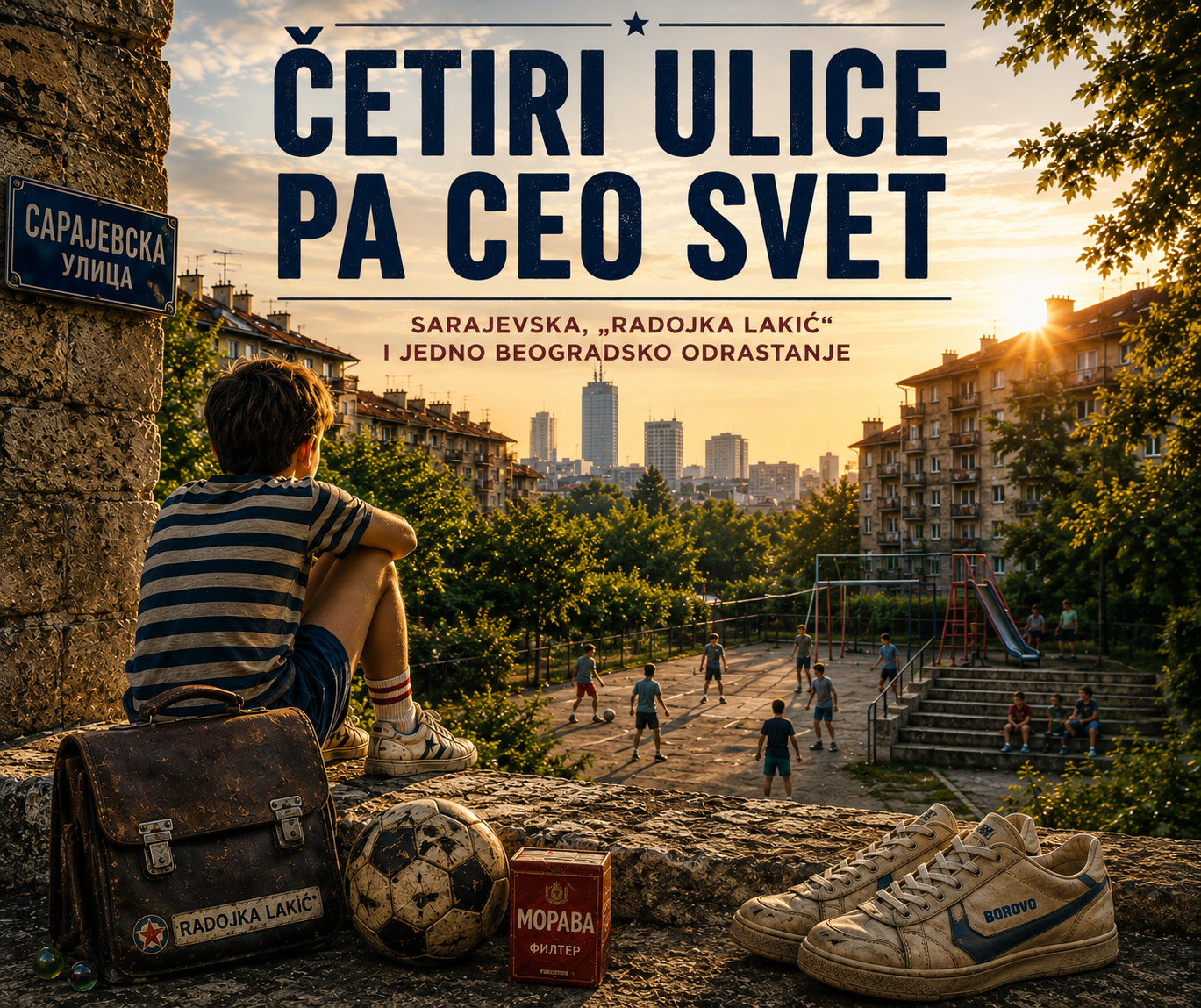
Sarajevska, “Radojka Lakić”, and a Belgrade Childhood
On the first of September, a new generation of first-graders begins school. One of them is mine.
I suppose that is what sent me digging through my own childhood. I started with the things that had stayed lodged in my memory. 1991, for instance, when a tank rolled down Sarajevska and crushed a vintage Mercedes and a Zastava 101. You do not forget something like that. Nor do you forget the queues outside Jugoslavijakomerc to buy a Sony television or some other coveted piece of Sony equipment. Or the crowd in Risanska during the long school break, everyone trying to get a hamburger from the fast-food place run by the father of one of the boys from the neighbourhood.
But my first world did not stretch across fifteen streets.
It was much smaller.
It was bounded by Birčaninova, Kneza Miloša, Vojvode Milenka and Sarajevska. Those four streets formed a block, and behind the buildings, hidden from the road, were the courtyards. That was where our first friends lived. That was where we played, fought, made up, climbed trees and learned which passage would get you somewhere faster.
At the centre of it all was one large courtyard. If someone said the courtyard, everybody knew which one they meant. It was arranged on three levels, with a little garden between them. Up at the top, towards the park in Kneza Miloša, stood a row of temporary buildings where some of our friends lived. That was also where the famous Cat Lady lived, an elderly woman who fed every stray cat in the neighbourhood.
Beside the buildings were wooden sheds. The older people said the municipality had built them years before for residents whose basements flooded, so they would have somewhere dry to keep firewood. That was before our time. What mattered to us was that the shed doors were the centre of every game of hide-and-seek.
Reach the door first and you were safe.
That upper level also had seesaws, swings and a sandpit, mostly for the smaller children who came down with their parents. In winter, the slope leading to the next level became our sledding hill.
The middle level had a flat patch where we played football. Older boys from the neighbourhood said proper tournaments had once been held there. On one side stood a tall, stepped wall that you could climb over into a smaller courtyard. On the other was a stone drinking fountain that somebody had eventually shut off.
That was simply how things worked back then: if you were sweaty, you did not drink cold water.
You would get sick.
End of discussion.
Farther down came a small slope, a path and a flower garden. The path was effectively the courtyard’s main highway, connecting its two principal entrances: the upper one from Birčaninova and the lower one from Sarajevska. Cars did not come into the courtyard, so the path belonged to us.
The flower garden was kept so beautifully that even we, wild as we could be, did not go trampling through it. If the ball landed there, you went in, picked it up and came straight back out.
Carefully.
There were things you simply knew not to touch.
Farther down the path stood a great linden tree.
I can still remember the smell.
The third level was paved. Everybody knew where you played ten-nine, where you played dodgeball, where the marbles belonged and where you kicked a ball around when there were only two of you. We spent half our lives hammering balls against the walls beneath people’s windows, and I cannot remember anyone ever chasing us away because of the noise.
Every now and then, a ball would sail straight through an open window and into somebody’s flat. We knew whose flat it was, so we would stand below and shout until the ball came flying back out through the same window.
The families living there were the families of our friends anyway.
Near the Sarajevska entrance lived an elderly woman who had been a major in the Partisan forces during the war. She treated us like grandchildren and knew every one of us by name. Sometimes she would bring us a little something from Srbijanka. Often we did not even notice her watching us play from the lightwell above.
The courtyard was full of trees and fruit. Mostly plums, which, for reasons that seemed entirely logical to us at the time, were eaten exclusively while still green.
Even the trees had their own hierarchy.
Some were easy, like the Japanese crabapple. Others had to be figured out. You needed to know where the knots were, where to place your foot, where your hand had to go.
Nobody taught you.
You watched the older boys and tried.
The cherry tree was a different story altogether.
It stood in a small courtyard that was almost impossible to reach by any normal route. The door through the building was usually locked, the embassy bordered it on the other side, and whenever the cherries ripened, the neighbour tied a Dobermann to the tree.
Fine.
If you could not get there the normal way, you went over the roofs.
The branches stretched towards the roofs of those temporary buildings. You climbed up, crossed the rooftops to the far end, tried not to be spotted and chased by one of the residents, and then swung yourself onto a branch.
Then you sat in the cherry tree eating fruit while the Dobermann barked and jumped below, and we spat cherry stones down at him.
To us, perfectly normal.
There was also the park in Kneza Miloša, the one with the rocket. We did not spend much time there. Before long, they demolished it, started building something and then stopped. What remained was a concrete shell that filled with water. Plants took over. Frogs moved in.
Immediately much more interesting.
We would climb across the roofs to get onto the abandoned construction site, walk along narrow concrete walls above the water and squeeze through the fence straight onto Kneza Miloša.
Looking back now, I am not entirely sure what we thought we were doing.
At the time, apparently, we did not think anything of it.
I remember taking that very route into Kneza Miloša on the famous 9 March 1991. I looked towards Beograđanka and saw a line of police, demonstrators and a car on fire.
I was twelve years old and, naturally, had very little idea what was actually happening.
I only knew that this was not an ordinary day in the neighbourhood.
And I had reached the middle of it, as I had reached so many other places before, by taking our shortcut through the abandoned building site.
Every neighbouring block had something of its own.
One had a basketball court. If you threw the ball too hard, it landed inside the grounds of the American embassy. That was one fence you did not climb.
You shouted instead and waited for the Marines guarding the embassy to throw the ball back.
They always did.
As we grew, our territory grew with us. Four streets became six, then eight, and eventually the full fifteen that made up our world. Every new street brought another courtyard, another passage, another playing field, another kiosk, another rule you had to know if you were from there.
The boundaries were perfectly clear: Kneza Miloša, Nemanjina, Krcunova — today Savska — and, towards Mostar, the park and then the interchange.
Nobody ever drew us a map.
Nobody had to.
You simply knew where you were.
Across Nemanjina lay Hotel Beograd, Balkanska and Bazenski Park. Across Krcunova — Savska — were the post office, the railway station and the tracks, and beyond them the Sava. Across Kneza Miloša you went towards “Njegoš”, with the health centre beside it.
That was probably the only time we genuinely had to leave our fifteen streets: when you were ill.
If you were sick, you went to Dr Filipović. And being sick often meant seven days of injections.
Then you got your school note and that was that.
I remember a teacher once saying:
“You lot from inside the Number Two circle should…”
We immediately protested.
“We’re not inside the Number Two circle.”
And we weren’t.
He laughed, while outside the window, right on cue, the Number Two tram rattled along Nemanjina.
That made it even funnier to him.
Not to us.
We knew perfectly well which side of the tracks we were on.
Sarajevska ran right through our little territory, both the odd-numbered side and the even-numbered side.
The main street.
And within those fifteen streets, you had almost everything you needed. Embassies, the police, the courts, government offices, Hotel Turist, Glavni ured, the playing field in Brodarska and the kafana beneath the stands.
But those were not what made the neighbourhood.
The neighbourhood was made by the shops, bakeries, kafanas, kiosks, craftsmen, mechanics working out of courtyards, and people you knew.
In Sarajevska, everybody knew where you bought sheets of pastry, where you bought bread, where the burek was good and where to get pastries.
If you did not know where to buy what, you were not from there.
For us kids, Soko Štark was a serious institution. Centroprom was where the household shopping was done. There was Jugoslavijakomerc, the large Savremena administracija bookshop and the taxi rank on the corner of Birčaninova.
Nothing remarkable to us.
It was simply the neighbourhood.
Just off Sarajevska was Teslina — today Dr Aleksandra Kostića — and there, in Teslina, stood the small “Radojka Lakić” primary school. Named after a Yugoslav Partisan heroine.
That was where our Class Three began.
Our class carried the number three from first grade all the way to eighth, from 1985 to 1993. Almost all of us lived within those same fifteen streets.
Our first teacher was Milena Milenković. Tall, solidly built, blonde — one of those people who possessed authority before they even opened their mouth.
Her presence was enough.
And, as it happened, she too lived in Sarajevska.
She smoked red Filter Morava cigarettes, the pack with the Cyrillic lettering.
How do I know?
We all knew.
There was hardly a child in the class who had not, at least once, been sent to buy her cigarettes. As unbelievable as that may sound today, at the time nobody thought much of it.
You walked out of school without crossing a single street. Left from Teslina into Risanska, past Šlajmara, up to the top of Risanska, and then to the kiosk at the beginning of Hajduk-Veljkov venac.
“Filter Morava. The Cyrillic pack.”
If they were out, there was another kiosk across the road.
Milena had a kind of authority that is difficult to explain today. Especially since, early in her career, she had also taught some of our parents.
There was not much room for negotiation.
I remember my mother telling me about one parents’ meeting when the subject of shoes for physical education came up.
Milena settled it immediately: the cheapest Borovo trainers, from the shop in Hajduk-Veljkov venac.
And that was that.
I do not think we thought much about social differences back then. We were friends because we were children. There was no calculation, no wondering who might one day be useful to you, no real idea of what sort of family anybody came from.
As far as we could tell, everybody had enough.
And if there was some difference we might have noticed, Milena cut it off at the root.
Borovo trainers for everyone.
End of discussion.
We knew where she lived too. In that part of Sarajevska, you somehow remembered your manners without being reminded.
We did not spend much time in the courtyard of her building.
Why tempt fate?
That was how we grew up. Some of us spent eight years together, some even longer. Before school, the same people. At school, the same people. After school, the same people again.
And then, in 1993, we finished eighth grade and scattered.
Not all at once, and not completely.
Everyone simply went in a different direction, and after enough years had passed, you realised there were people whose whereabouts you no longer knew at all.
Today I pick up our old class photograph.
A few names come immediately. The closest friends. The ones with unusual first names or surnames.
Then the gaps begin.
I know the face. I remember where they sat. I remember some stupid thing that happened during break. Sometimes I can almost hear the person’s voice.
But the name will not come.
I turn the photograph over. There are signatures on the back, half of them nicknames.
Perfectly adequate in 1993.
Not much use today.
The girls are even harder: Ana, Dragana, Jelena.
If she changed her surname, good luck.
So you start piecing things together. You find one person, then another through them. Someone posts an old photograph. You look at who liked it, who commented.
One name leads to another.
Eventually even the algorithm works out what you are doing and begins offering you familiar faces.
You stare at someone.
No.
Can’t be.
It is.
You just happen to have last seen him when he was fourteen, and now he is nearly fifty.
Of course he does not look the same.
Neither do you.
I do not really know those people anymore.
I knew them then.
In the years since, each of us has acquired a life of our own: families, jobs, moves, successes, failures, everything that comes with growing older. The neighbourhood dispersed, and today I do not know whether any of us still lives at the same address.
I would like to think someone does.
And I would be glad if one of their children were walking those same streets today.
But the address is not really the point.
I do not expect us to be friends after more than thirty years simply because we once sat in the same classroom.
Still, there is something slightly absurd about spending eight years together and then becoming complete strangers.
Chances are we have already passed one another somewhere. On the street. In a shop. At the doctor’s. Perhaps we have even sat at neighbouring tables.
You look at someone and have no idea that you once spent eight years of your life with them.
You do not need to know where they live, what they drive or where they go on holiday.
It would be enough to know who they are, what they do, and to say hello when you meet.
One became a doctor. Another a lawyer. Someone works in a school. Someone knows a good tradesman. Someone knows something you do not.
Not so they can pull strings for you.
That is something else entirely.
But if someone in healthcare whom I spent eight years with tells me:
“If it were my child, this is the doctor I would take them to.”
Well, that means something to me.
Today there would probably be some sophisticated term for that sort of connection.
We used a simpler one.
Our people.
We lived only a few minutes from one another. We knew whose window belonged to whom, whose brother was whose, where each family bought its bread, and which courtyard you stayed out of unless you had a reason to be there.
And then we lost one another.
Children today have phones, group chats, Instagram, WhatsApp and whatever else will come next. In 1993, we had none of it.
But I am not convinced technology is what makes the difference.
So now, as another generation of first-graders sets off for school — one of them mine — I find myself looking at all this a little differently.
They do not have to remain friends forever.
It would simply be good if, one day, they could pick up an old photograph from first grade, look at a face and say:
“I know who that is.
I know where they are.”
After eight years together, that does not seem like too much to ask.
Author: Nikola Skeledžija
© 2026 Nikola Skeledžija. All rights reserved. Quotation is permitted with proper attribution to the author and source. Reproduction, distribution or adaptation of this text, in whole or in part, without prior written permission of the author is prohibited.