
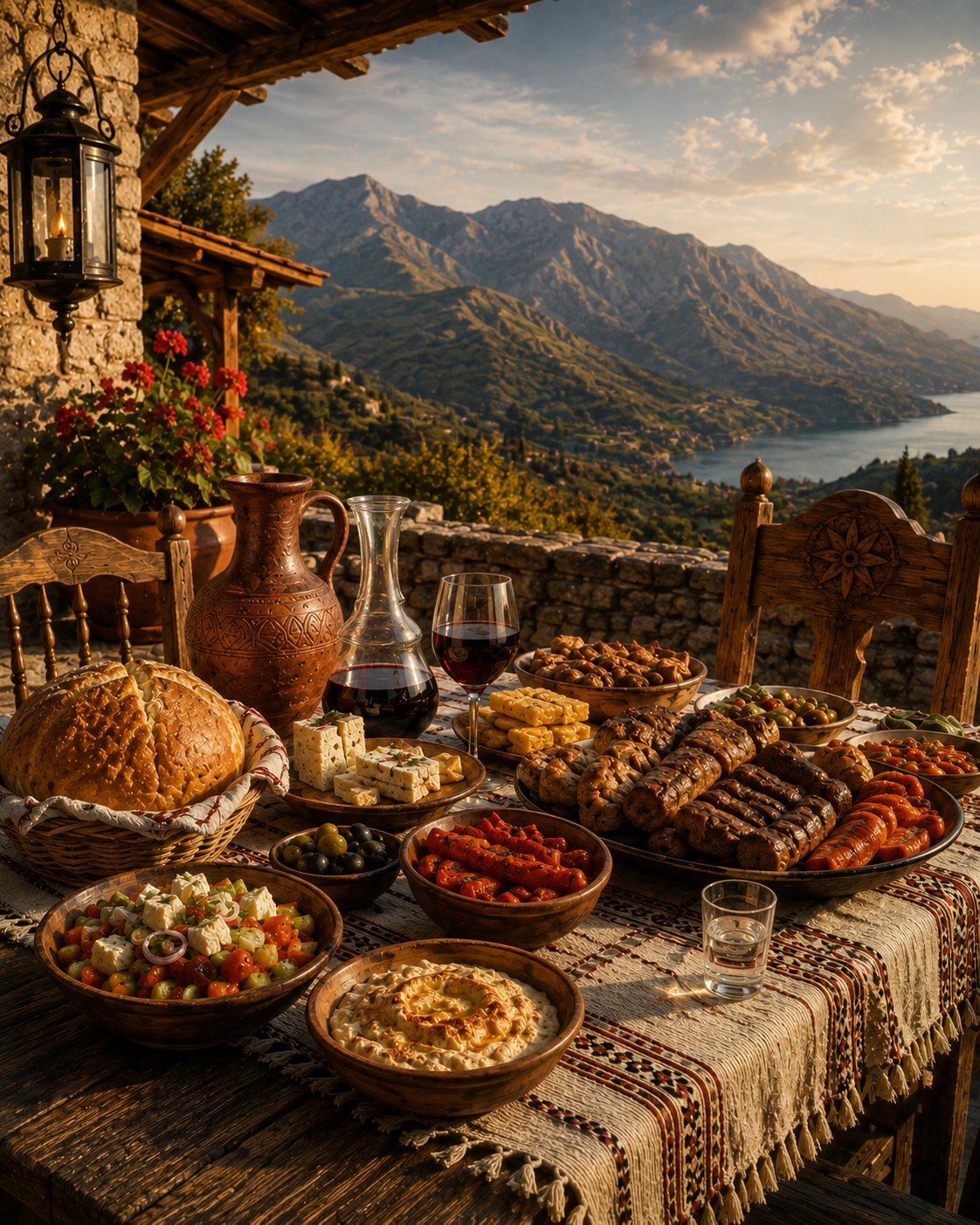
The Honour of the Host in Balkan Folk Tradition
DIPTYCH — PART I
The languages of the Balkans have never suffered from a shortage of insults. Quite the opposite. We have enough of them to insult a man, his intelligence, his origins, his family and several generations of his ancestors.
And yet one of the gravest accusations you can make against someone in this part of the world does not require a single swear word.
He invited me into his home, but he did not treat me as a guest.
Or worse:
I left his house hungry.
That is not a complaint about lunch. It is not a restaurant review. You are not saying that you disliked the meat, that the wine was poor or that the portions were too small.
You are saying something far more serious:
He was no host.
For centuries, in the traditional cultures of the Balkans, the relationship between host, guest and table was bound up with personal and family honour. A man who opens the door of his home to you is not merely allowing you into the place where he lives.
He is taking you under his roof.
And by doing so, he assumes an obligation towards you.
There is a reason the old saying arose:
“A guest in the house is God in the house.”
A guest was offered the best the household had. What “the best” meant depended entirely on the household.
In one home, meat and wine.
In another, cheese, bread and rakija.
Elsewhere, perhaps only the little the family could afford.
Luxury was never the point.
Intention was.
The guest was never supposed to feel like a burden.
A Man Reveals Himself at the Table
Few things illustrate how deeply rooted this relationship is more clearly than Balkan epic poetry.
In Banović Strahinja, before the abduction, pursuit and duel for which the poem is remembered, there is something far more ordinary at first glance:
the arrival of a guest.
When Strahinja reaches Kruševac and the household of Jug Bogdan and the nine Jugović brothers, the poem does not pass over his reception as an insignificant detail:
“Gladly did they welcome their beloved son-in-law,
And took him warmly into their arms…”
Then they sit at the prepared table. Some attend to him; others pour the wine.
The guest has been received, served and honoured.
But another detail may tell us even more.
Other noblemen want Strahinja to visit their homes as well, and ask Jug Bogdan to bring him:
“Into our courts and into our homes,
That we too may do him honour.”
That we too may do him honour.
Receiving a guest into your home was not presented as an inconvenience to be endured.
The opportunity to welcome him beneath your roof was itself an honour.
Three Acts of Inhumanity
The message is even more explicit in Marko Kraljević and Beg Kostadin.
Beg Kostadin invites Marko to his family feast and boasts of the hospitality awaiting him:
“Then you shall see honour and good cheer,
And a fine welcome too, my brother…”
Marko replies that he has already seen what Kostadin calls hospitality.
He does not tell him that he is merely a poor host.
He does not call him rude.
He does not even criticise the food.
He says that he has witnessed:
“three acts of inhumanity.”
It is worth stopping at that word.
Inhumanity.
The folk poem takes a man’s treatment of another person at his table and raises it to a question of his very humanity.
Marko sees Kostadin’s first act of inhumanity when two impoverished children come to his house and beg:
“Give us white bread that we may eat,
And red wine that we may drink.”
Kostadin turns them away.
Not because he has nothing to give.
His house is full of food, wine and guests.
He turns them away because they are poor.
Marko then takes the children with him, feeds them, gives them drink, dresses them in fine clothes and brings them back before the same host.
This time Kostadin does not send them away.
Now he invites them in:
“Eat and drink, you sons of gentlemen.”
And with brutal simplicity, the folk poem exposes something that has hardly disappeared from the world today.
The food was there the first time.
Only the clothes of those asking to eat had changed.
Kostadin’s second act of inhumanity concerns the table even more directly.
Noblemen who have fallen into poverty are seated at the lower table, while men who have only recently become wealthy are given places at the upper one. Before them he sets wine, rakija and the finest delicacies.
So the question is not what is on the table.
The question is whom you consider worthy of sitting at it.
Marko sees the third act of inhumanity in the fact that Kostadin’s father and mother are both alive, yet neither has a place at his table:
“Neither one sits at your table,
To drink the first cup of wine.”
Three different acts.
The same judgement.
Inhumanity.
You may have a house full of guests.
You may have wine and rakija.
You may lay out every delicacy you possess.
You may surround yourself with men of rank and reputation.
And still be a poor host.
Because a table is never merely what has been placed upon it.
At the table, you see the character of the person sitting at its head.
That Is Why the Accusation Is So Serious
Once this is understood, the sentence
“I was his guest, and he did not treat me as one”
no longer sounds harmless.
In a culture whose folk poetry describes the mistreatment of another human being at the table as inhumanity, accusing someone of failing to receive you properly strikes far deeper than his cooking.
It strikes at his honour as a host.
And an accusation of that kind must have substance behind it.
If someone invited you beneath his roof and then deliberately left you hungry, ignored you, humiliated you or treated you as less worthy than his other guests, then he violated a very old rule.
And he deserves the shame that follows.
But there is another side to the table.
The guest.
If you were welcomed, offered food and drink, served properly and seen off with respect, and then claimed that you had been left hungry and dishonoured merely in order to humiliate your host, you have deliberately reached for one of the most serious accusations available in this part of the world.
At that point, the accusation says very little about the host.
It says a great deal about the shamelessness of the guest.
Because if there is such a thing as the honour of the host, there must also be such a thing as the honour of the guest.
Even an Enemy Is a Guest While He Sits Beneath Your Roof
The strength of the obligation towards a guest becomes clearest when the guest is not a friend at all.
A man with whom you have a dispute may be your adversary. There may be a debt between you, an insult, even blood.
But once he has been received beneath your roof as a guest, a different relationship takes effect.
In traditional Albanian customary law, commonly associated with the Kanun of Lekë Dukagjini, hospitality was governed by an entire system of rules. One of the Kanun’s best-known formulations describes the house as belonging to God and to the guest. Rules governing the reception and protection of guests occupy a particularly important place within that customary order.
Most striking of all is the fact that even a blood feud did not necessarily extinguish the protection owed to a guest. A man from an enemy family who had been received as a guest and given besa came under the protection of his host.
Put simply:
You may have a blood debt with a man, but while he sits beneath your roof as your guest, you are obliged to protect him.
There will be time enough for enmity once he has crossed the threshold again.
The host’s responsibility did not end with refraining from harming the guest himself. The guest’s safety became a matter of the household’s honour. An attack upon a guest under a host’s protection was an attack upon the host’s own honour.
This was a harsh world of customary law, and it should not be romanticised. Blood feud is neither a value to be defended nor a model for modern society.
But precisely within that harsh world we can see how powerful the institution of the guest once was.
Even an enemy faced a boundary the host himself was not permitted to cross.
The threshold of the house.
Times Have Changed. The Relationship Has Endured.
Centuries have passed since the world described in those folk poems. The old sofra has largely disappeared. Homes have changed, families have changed, the way we live has changed, and so has the table itself.
Today we have fine dining, tasting menus, small portions arranged across several courses, contemporary techniques and deconstructed versions of traditional dishes. We have buffets, self-service, open bars, cocktail receptions and countless modern forms of service.
Instead of a jug of wine in the middle of the table, a carefully selected glass may arrive with each course.
Almost everything about the way we prepare, serve and present food has changed.
But one ancient Balkan pattern has survived.
The relationship between host and guest.
Even today, when we invite someone into our home, we almost instinctively ask whether they are hungry, what they would like to drink, what they enjoy eating and what they avoid.
We put out more than is necessary.
We offer again even after the guest has already said they cannot eat another bite.
And when a larger celebration is being organised, that old fear of the host — the fear that something might run out — perhaps becomes most visible of all.
I know this from my profession as well.
For years I have watched the same thing happen. Whether a celebration is organised by professional caterers or entirely by the host, food and drink are almost invariably planned with a substantial margin to spare.
As though far more people might arrive than were ever invited.
Anything rather than face the moment a Balkan host fears most:
that something might run out in front of the guests.
That is why our weddings, birthdays, religious celebrations, holiday gatherings and family occasions so often end with far more food and drink left over than anyone could possibly have needed.
From the perspective of rational planning, this may look like poor calculation — even waste.
From the perspective of the Balkan host, running short is far worse.
The excess can always be divided up, packed away, eaten the next day or sent home with the guests.
But the moment when a guest reaches for something and discovers that there is none left —
the host remembers that.
And there, perhaps, we can see most clearly just how deeply the old pattern has survived.
Not because we have all read the old epic poems or studied the Kanun.
But because the relationship itself has remained embedded in the culture.
Even today, throughout the Balkans, you will hear a host apologising that there is “nothing special” to eat while the table in front of the guest is overflowing.
Even today, the best piece is often saved for the guest.
And even today, the question
“Have you eaten?”
often means far more than a simple enquiry about hunger.
It is another way of saying:
You are welcome here.
Of course, circumstances have changed. Hospitality is not measured in kilograms of food or by the number of plates on a table. Nobody needs to place half a roast lamb in front of a guest in order to prove themselves a proper host.
You may welcome someone with a tasting menu of several carefully prepared courses.
You may offer nothing more than bread, cheese and a glass of wine.
You may simply make coffee.
Because the essence of hospitality was never merely how much food was placed on the table.
The essence is that the person who entered your home should feel that you wanted them there.
The sofra may have become a dining table. The dining table may have become a buffet, a bar counter or a tasting menu.
But the guest remains a guest.
And so the old measure has survived:
A host is known by the way he receives his guest.
The Honour of the Host and the Honour of the Guest
But the table has never been a one-way relationship.
The host opens the door of his home, brings out what he has and shows how much the person seated at his table matters to him.
But the story does not end there.
The old saying tells us:
“A guest in the house is God in the house.”
Yet the guest does not leave his own honour outside when he crosses another man’s threshold.
A host is known by the way he welcomes, serves and sees off his guest.
A guest is known by the way he responds to the hospitality he has received.
There is shame in being a host who fails to honour his guest.
But there is also shame in being a guest who has been properly received and then claims that he was not.
In a part of the world whose languages possess no shortage of curses and insults, one of the gravest accusations of all can be spoken quite calmly:
“I was his guest, and I left his house hungry.”
If it is true —
let the host be ashamed.
If it is not —
then those words are not a measure of his hospitality, but of your own shamelessness.
Author: Nikola Skeledžija
© 2026 Nikola Skeledžija. All rights reserved. Quotation is permitted with proper attribution to the author and source. Reproduction, distribution or adaptation of this text, in whole or in part, without prior written permission of the author is prohibited.