
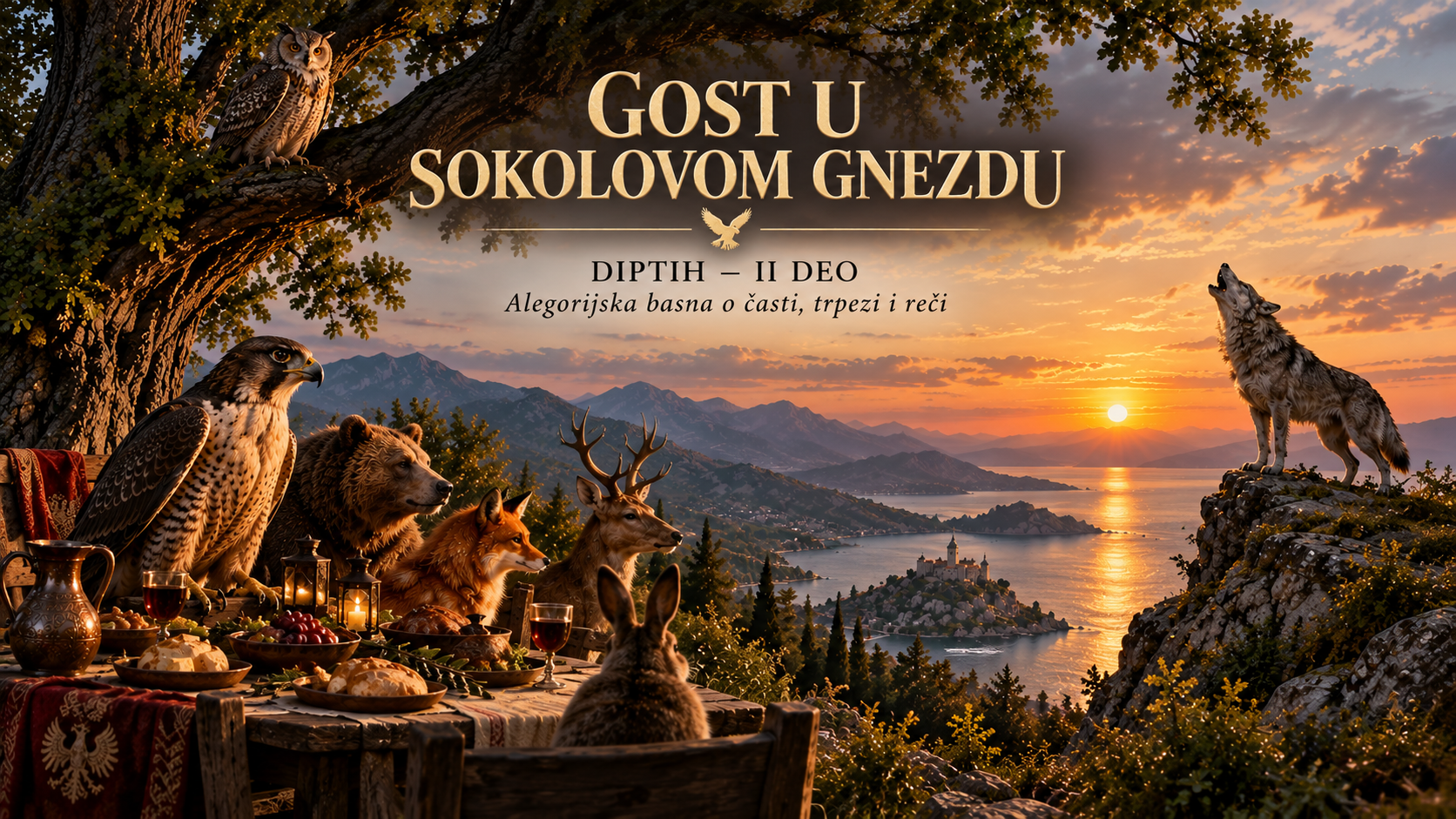
DIPTYCH — PART II
An Allegorical Fable of Honour, the Table, and the Spoken Word
There are events witnessed by many, yet later spoken of as though no one had seen them at all. And there are words which, if repeated loudly enough, attempt to alter what has already happened. Somewhere between fact and the story told about that fact lies a space in which truth no longer depends solely on what took place, but also on whom we have chosen to believe. This is a short fable about a table, a host’s honour, a guest’s word, and those who never sat at that table yet were the loudest when it came time to say what had been served upon it.
Before he ever set foot upon the rock, the Many-Faced Wolf was not thinking about his host. He was thinking about how to leave his mark. So first he sent ahead a great bird of iron and steel, packed with a pack of feral jackals. Their task was not to greet the host, nor to learn anything about the land they were entering. They had come to be the first to land beneath the rock, to raise a clamour in his name, and to lay claim to what was not theirs.
But the Many-Faced One had forgotten an old truth. The Falcon is a bird, and his sky does not tolerate the uninvited. The guards upon the rock did not raise their voices. They issued no threats. They simply closed the way. The pack was sent back by the same route it had come, before it had so much as touched the stone. It departed carrying more noise than dignity with it. Only then did the Many-Faced Wolf understand that some boundaries cannot be crossed by shouting. When at last he reached the rock himself, there was a smile on his face, but no peace in his eyes.
High on a rock above the sea, the Falcon had prepared a table. Into his nest he invited the Grey Eagle of the Western Throne, accompanied by the Proud Rooster, the well-fed Tame Boar, and the Proud She-Wolf from the Eternal South. Opposite them took their places those who were both his neighbours and his kin, those with whom he had shared, across centuries, glory and hardship, love and hatred alike: the Many-Faced Wolf, the Brown Bear from the wild forests, the Clever Marten, the Mountain Black Eagle, the Proud Lynx, and the Refined Lipizzaner.
The Falcon had not prepared the feast to display his wealth. He had prepared it because he had been raised by an old rule: a guest must be welcomed with the best the household has to offer. He gathered his people and said: “Do not ask who is coming to us. Ask only what else we can place upon the table.” That day the mountains were searched, the rivers explored, and boats put out to sea. From the pastures came the finest the herds could provide. From the rivers, the freshest catch. From the sea, whatever the nets had yielded that morning. From the olive groves, oil. From the vineyards, wine. From the orchards, fruit ripened beneath the sun. He did not choose what was most expensive. He chose the best his land could give. For a host does not measure his honour by what he keeps for himself, but by what he places before his guest. The table was not lavish for the sake of display. It was abundant out of respect.
There was little talk at the table. The Grey Eagle remained reserved, the Proud Rooster openly delighted in the feast, while the others ate quietly. Only the Many-Faced Wolf spent more time looking around him than at what lay before him. When the plates were empty, the guests rose from the table. The Wolf said nothing. He thanked his host as custom required, extended his hand, and left the nest in peace. Not once did he mention hunger.
Only after he had returned to his pack — the same pack that had been driven away from beneath the rock with its tail between its legs — did he stop before them, raise his head, and let out a howl that rolled through the valley: “The Falcon left me hungry! There was nothing on the table but bird’s dew!” The pack answered with a howl of its own. Not because it had been at the table. It had not. It howled because it trusted its Wolf more than a truth it had never witnessed.
The Wolf had not been counting on those who had sat at the table. He had been counting on those who had never been there. For a lie takes root most easily where there are no witnesses. And in that part of the world, there are few accusations more serious than saying that a guest left his host’s house hungry. That is not an insult to the food. It is not an insult to the table. It is a blow against the honour of the host, his family, and the entire people who had spent days gathering the best they had so that a guest might be received as custom demands.
On a nearby branch of an ancient oak sat the Wise Owl. She listened as the howling faded among the mountains, then said quietly: “People have lied for as long as people have existed. But a lie becomes dangerous only when it is repeated by those who were never there to witness the truth. A man who leaves a full table and then claims he went hungry is not speaking about his host. He is speaking about himself. Honour cannot be stolen by words. It can only be lost through deeds.”
The birds continued their flight. The sea remained calm. The rock remained where it had always been. Only the valley, for a little while longer, carried the fading howl of a Wolf who believed that sheer volume could overpower the memory of those who had sat at the same table.
Author: Nikola Skeledžija
© 2026 Nikola Skeledžija. All rights reserved. Quotation is permitted with proper attribution to the author and source. Reproduction, distribution or adaptation of this text, in whole or in part, without prior written permission of the author is prohibited.