
I run into former students.
Sometimes only a few years have passed since they left school. Sometimes twenty.
I recognise some of them immediately, usually the best ones or those I spent the most time talking to. With others, I cannot always remember the name straight away.
Time does that.
People change. They grow up. They build lives of their own. Sometimes I need a moment to connect a face with an event, a class, or someone else from their generation.
And then the memory comes back.
Almost inevitably, the same question follows:
“Professor, are you still at the school?”
As though they are surprised to find that I am still there.
I have never felt that I stayed because I had no other choice.
I did not stay because I cannot do anything else, nor because I never had the opportunity to leave.
I stay because I chose to.
Of course, teaching comes with plenty of administration. That is part of the job. Sometimes it is frustrating. Sometimes it takes far more time than it should.
But that is not why I am here.
The reason is young people.
Conversation Comes First
From the very beginning, I have insisted that we talk.
There are no stupid questions.
We do not always have to agree, but we do have to talk.
It is the only way I can understand what drives a student, what holds them back, and what they actually want.
Without that, there is no trust.
And without trust, it is very difficult to guide anyone.
When the Teacher Gets It Wrong
I often think about one student from the early years of my teaching career.
He was one of the most talented students I ever taught.
Excellent in theory, even better in practice. Calm, disciplined and responsible.
I was convinced that he had a serious career ahead of him in top restaurants, so I found him a placement that would take him in exactly that direction.
When the placement was over, we talked.
I cannot remember his exact words anymore. Almost twenty years have passed.
But I remember what he meant.
Fine dining did not interest him.
He saw himself working with traditional and national cuisine.
That was when I realised I had got it wrong.
I had seen him where I thought he ought to be.
I had not listened carefully enough to where he saw himself.
Many years later, a head chef said something to me that stayed with me:
“There is no single path for every cook. Some belong in fine dining. Some in national cuisine. Some in pastry. Some in competitions. Some are meant to run kitchens. Some are meant to teach.”
The more years pass, the more I think he was right.
The following week, we found that student a place that suited him better.
Talent is worth little if you cannot see yourself in the life it leads to.
That may be one of the most important things I have learned from working with young people.
As a teacher, I can suggest a direction. I can open certain doors and put a student in touch with people they can learn from.
But I cannot live their life for them.
It is not enough for me to believe in that path.
They have to believe in it too.
We Work With Young People
Working with young people is not simple.
These are the years when they are trying to find out who they are. They change their minds. They make good decisions and bad ones.
Sometimes they surprise you in the best possible way.
Sometimes they disappoint you.
Bad grades can be fixed.
What hurts far more is watching someone give up on themselves.
Sometimes you judge things well.
Sometimes you get them wrong.
That is part of the job.
And then there are the hours of conversation that have very little to do with cooking.
We talk about family, friends, love, problems, plans and mistakes.
It takes time.
But that, too, is part of the job.
Because we are not working only with future cooks.
We are working with young people.
A Job Done in the Background
Over time, I have come to accept something else.
A teacher’s work is, for the most part, work done in the background.
I did not train to become a teacher.
I trained to become a cook.
Teaching was nowhere near my plans at the time.
But life, as it happens, had other ideas.
Years of learning, professional development and experience followed, but the foundation remained the same.
Even today, I still think of myself as a cook first.
People see head chefs, restaurant owners and successful professionals.
They rarely see the people who were there at the beginning of their journey.
And that is where a teacher is most often found.
At the beginning.
Showing them the foundations of the craft. Helping them make their first professional connections. Opening a few of the first doors.
After that, the path belongs to them.
I Measure Time in Generations
Today, I handed diplomas to another generation of students.
I tried to keep it short, not because I had nothing to say.
Quite the opposite.
There was a great deal in my head.
But I know myself.
Once I start, emotion catches up with me.
That is why writing is sometimes easier for me than speaking.
After four years together, some kind of bond is bound to form.
You spend a great deal of time together. You go through good moments and bad ones.
And then, one day, everyone goes their own way.
Perhaps that is why I stopped measuring time only in years a long time ago.
I measure it in generations.
One generation arrives, spends four years with us, and leaves.
Then another one comes.
I meet some of them again after five years. Others after twenty.
Some become outstanding chefs.
Some take completely different paths.
And that is probably exactly as it should be.
My job was never to decide where they had to end up.
My job was to teach them the craft while they were with me, open a few doors for them, sometimes stop them when they were heading in the wrong direction and, as far as I could, help them find a path of their own.
So when a former student runs into me years later and asks:
“Professor, are you still at the school?”
the answer is simple.
Yes.
I am still there at the beginning of someone’s journey.
I am still doing the job I chose.
Author: Nikola Skeledžija
© 2026 Nikola Skeledžija. All rights reserved. Quotation is permitted with proper attribution to the author and source. Reproduction, distribution or adaptation of this text, in whole or in part, without prior written permission of the author is prohibited.
-
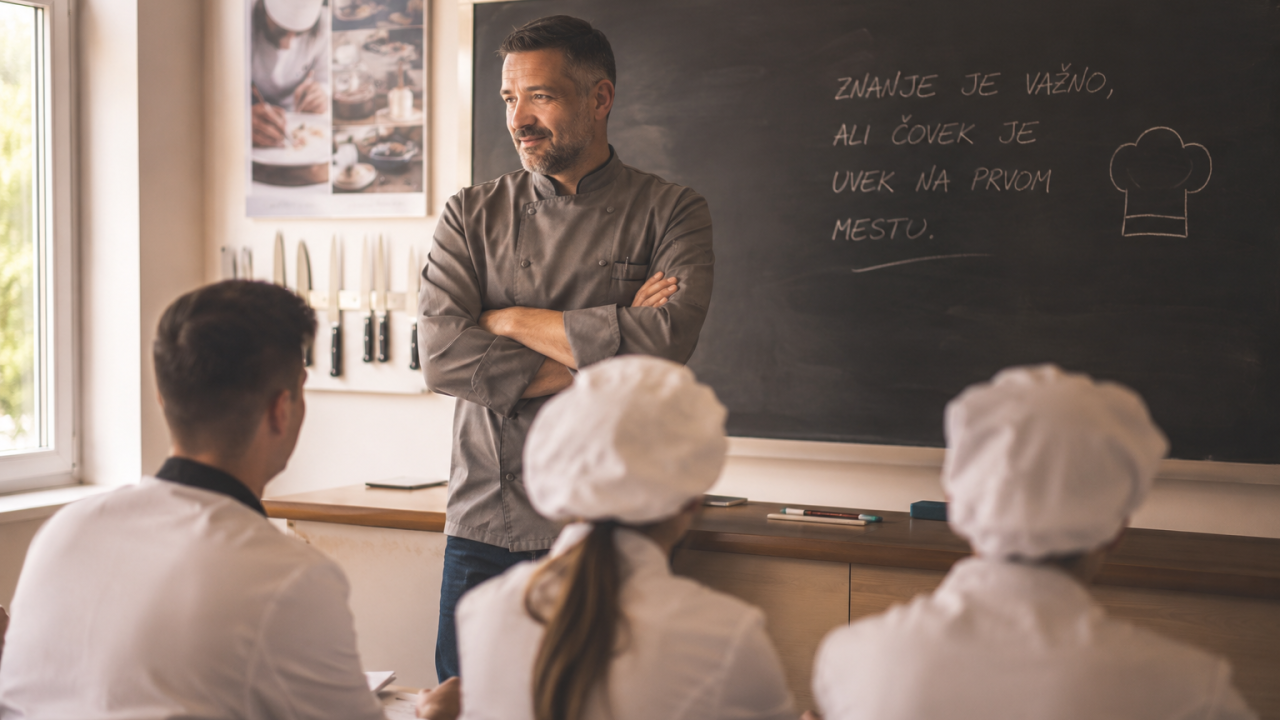
Why I Stay in Education