
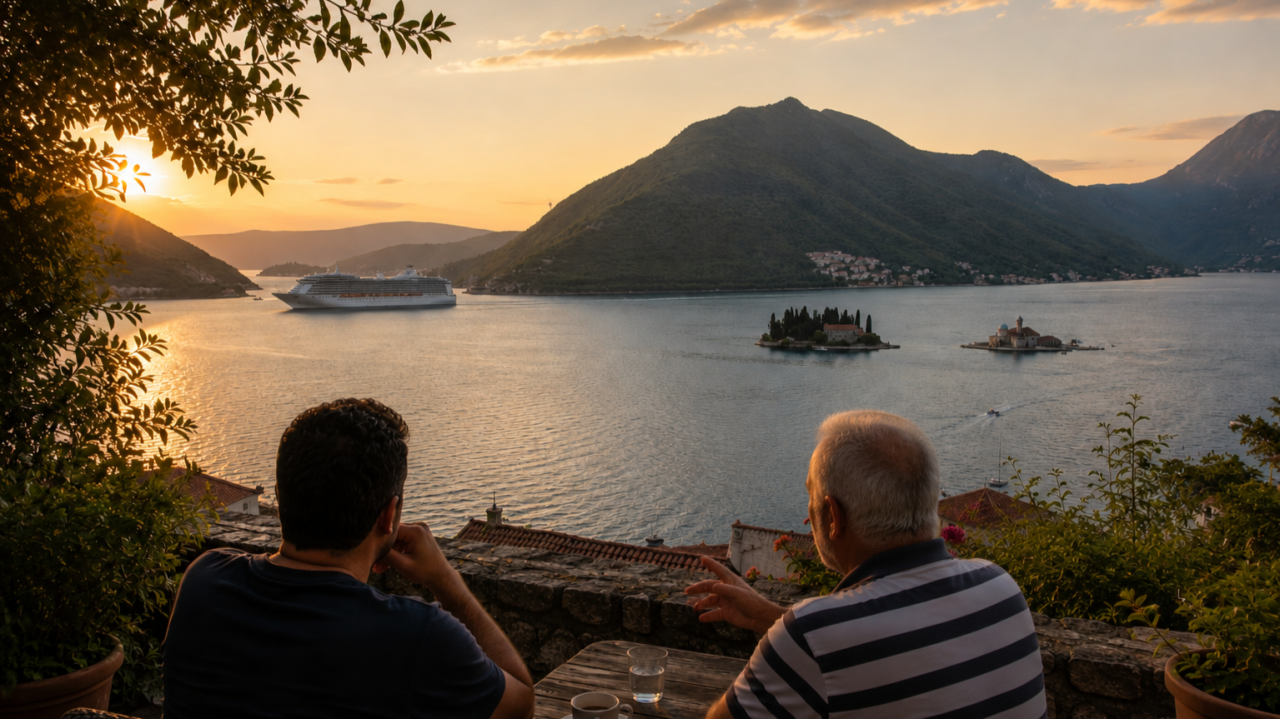
I am sitting in the garden with my neighbours. With people who live here, for whom this bay is part of everyday life.
The sun is slowly setting behind the hills.
We are sitting in the shade of citrus trees and camellias, looking out towards Perast and the Verige Strait.
Then, suddenly, the silence is broken by a ship’s horn.
A cruise ship is slowly making its way out of the Bay of Kotor.
We watch it go.
No one says anything.
After a few moments, I ask:
What do cruise ships actually bring to this place?
There is no single answer.
Everyone sees it from a different angle.
One person mentions the crowds. Another the traffic. Someone else points to the growing number of people filling the Old Town.
Others remind us that many families make their living from the cruise industry.
But one question keeps returning throughout the conversation.
Does what we gain justify what this place has to endure?
That question made me look more closely at what scientific research and professional studies have to say.
More Cruise Ships Do Not Simply Mean More Money
At first glance, the answer seems obvious.
More cruise ships mean more tourists.
More tourists mean more money.
But it is not quite that simple.
Cruise tourism generates revenue. Ports benefit from it, as do pilotage services, tour guides, excursion operators, taxi drivers, retailers and parts of the hospitality industry.
At the same time, research suggests that large numbers of cruise arrivals raise serious questions about pressure on infrastructure, traffic, public space and the long-term sustainability of a destination.
Which leads me to another question.
How much of that economic benefit actually stays with the people who live here?
Kotor is not the only place searching for an answer.
Norway, Venice, Dubrovnik, Amsterdam and Barcelona are no longer simply asking how to attract ever more cruise ships at any cost.
They are asking how tourism can be managed without destroying the very places people come to see.
Perhaps the Most Important Question Is the Sea
For Kotor, perhaps the most important question of all is the sea.
The Bay of Kotor is not merely a tourist postcard.
It is a sensitive marine ecosystem.
Scientific research shows that anchoring by large vessels can damage the seabed, while intensive maritime traffic and underwater noise can affect marine organisms.
I am not claiming that cruise ships are damaging fisheries in the Bay of Kotor.
A claim like that would require serious research carried out here, in this particular environment.
But I do think it is entirely reasonable to ask how the greatest natural asset of this bay can be protected in the long term.
Perhaps There Is Another Way
Perhaps some cruise ships do not need to enter the most sensitive parts of the bay.
Perhaps passengers could be transferred by smaller vessels with low or zero emissions.
Perhaps that would not be the right solution.
But I think it is worth discussing.
Because I would like someone, twenty, fifty or a hundred years from now, to sit in a garden, look towards Perast and the Verige Strait, and see the same bay that we are looking at today.
Author: Nikola Skeledžija
© 2026 Nikola Skeledžija. All rights reserved. Quotation is permitted with proper attribution to the author and source. Reproduction, distribution or adaptation of this text, in whole or in part, without the author’s prior written permission is prohibited.