
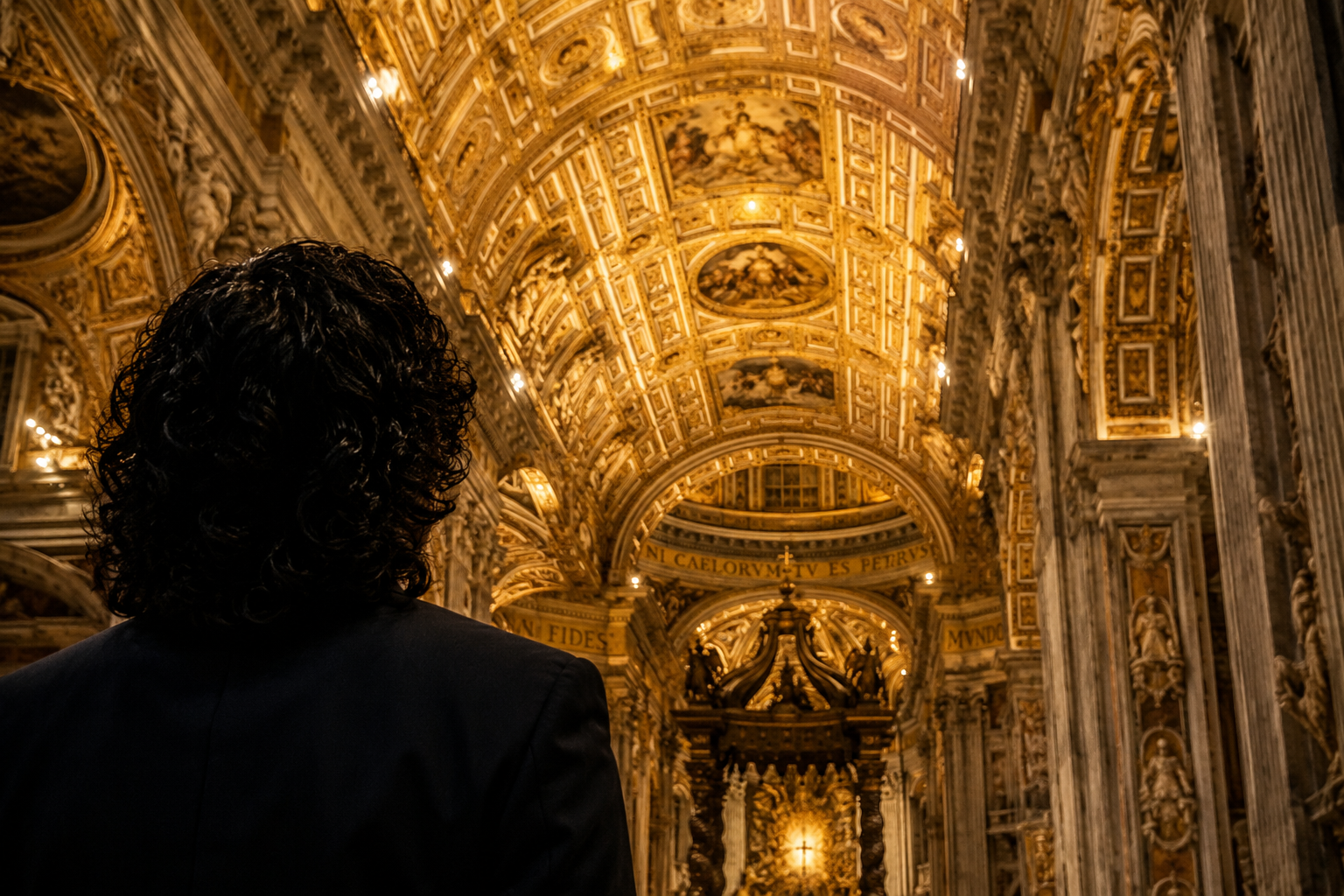
I came across a quote attributed to Diego Maradona.
Four short sentences.
I read them several times, then felt the urge to translate them.
Only then did I realise that what had stopped me was not the criticism itself, but the man who had spoken those words.
“Me peleé con el Papa porque fui al Vaticano y vi los techos de oro. Después escuché al Papa decir que la Iglesia estaba preocupada por los chicos pobres. ¡Vendé el techo, fiera! ¡Hacé algo!”
In translation:
“I fell out with the Pope because I went to the Vatican and saw the golden ceilings. Then I heard the Pope saying that the Church was concerned about poor children. Come on, sell the ceiling, man! Do something!”
I admit, I did not dwell on the quote itself.
I began thinking about the man who had spoken those words.
About Don Diego.
A man whom many consider the greatest and most influential footballer of all time, while others have never been able to separate the footballing genius from the man burdened by his own weaknesses. As though his greatest triumphs and his deepest falls had always walked side by side.
His life was woven from contradictions.
He was an idol to millions.
A champion.
A rebel.
A man who made mistakes.
But there is one thing that is difficult to deny.
He never forgot where he came from.
Born into poverty, among people who had very little, he never stopped speaking for those who had no voice, even after becoming one of the most famous people in the world.
We may agree or disagree with his views.
We may criticise his actions.
But it is difficult to find many people who reached that level of fame and were still willing to risk their popularity by saying what they truly believed.
That is why I did not read this quote as a criticism of the Vatican, or of any religious institution. That would be far too simple a conclusion. For me, those four sentences were not about gold. They were about responsibility. Not only the responsibility of the Church, but of every institution that speaks about values, every state that speaks about caring for its citizens, every company that speaks about social responsibility, and every individual who claims to care about others. The moment we say that something matters to us, we also accept the responsibility to prove it through our actions. Otherwise, our words remain nothing more than beautifully expressed thoughts. And history teaches us that societies are not changed by fine words. They are changed by deeds.
But the story does not end there.
Feeding a hungry person is an act of humanity.
If someone is hungry today, there is no more urgent task than giving them a meal.
But if we stop there, the hunger will return.
Perhaps as soon as tomorrow.
A meal can relieve hunger.
It cannot solve poverty.
Real help begins when we enable people to stop depending on help.
When they gain knowledge.
A skill.
An education.
An opportunity to work.
To provide for themselves and their families through their own labour.
To preserve what may matter most of all.
Their dignity.
The greatest act of charity is not to keep extending a hand to someone.
The greatest act of charity is to help them reach the point where, one day, they can extend a hand to someone else.
Perhaps that is why societies progress when they invest in education, knowledge, work and the dignity of their people.
Not because the need for compassion disappears.
But because compassion reaches its highest form.
I am not an idealist. I know there is no simple solution. I know that some people will need help throughout their lives. There are also those who, for different reasons, do not want to, or are unable to, break out of the vicious cycle of poverty and dependence. Sometimes the reason is illness, age, or circumstances beyond their control. Sometimes it is poor decisions. And sometimes it is simply the loss of faith that change is possible at all. That is why no society will ever eradicate poverty completely. But that cannot become an excuse to stop creating opportunities for those who want to stand on their own feet. Because opportunity does not guarantee success. But without opportunity, success is almost impossible.
Just as, in nature, the smallest snowflake can set an avalanche in motion, I would like to believe that one person can set change in motion within society. Not through loud words. Not through slogans. Not through promises. But through personal example. History teaches us that the greatest changes rarely begin with the majority. More often, they begin at the moment when one person decides not merely to speak about the values they believe in, but to live by them every day. Only then do their words acquire weight. Only then do they become an example. And an example has the power to move others. Perhaps that is how all great changes begin — quietly, almost imperceptibly, like a snowflake that sets an avalanche in motion.
If we look at this story from a spiritual perspective, we find the same thread running through the whole of human history. Saints, prophets and great spiritual teachers are not remembered for the beauty of their speeches, but because they lived what they preached. Their lives bore witness to their words. Perhaps that is why their messages still have the power to move people today. Because words can touch the mind. But example touches the conscience.
Perhaps Don Diego was speaking about golden ceilings that day. I heard something else entirely in his words. That the worth of a person, an institution or a society is never determined by their words. But by the deeds those words leave behind.
Author: Nikola Skeledžija
© 2026 Nikola Skeledžija. All rights reserved. Quotation is permitted with proper attribution to the author and source. Reproduction, distribution or adaptation of this text, in whole or in part, without prior written permission of the author is prohibited.