
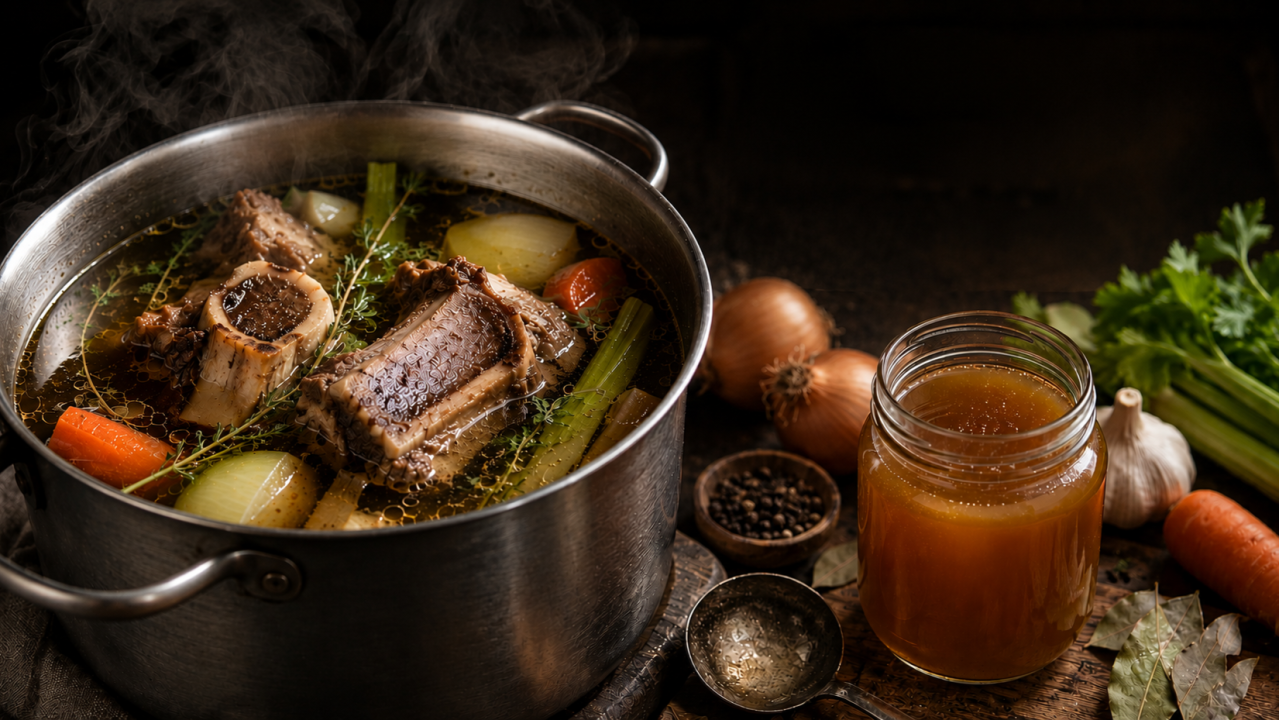
Preserving Classical Stocks in the Age of Instant Solutions
The hospitality industry has come under pressures in recent years unlike anything it has faced for a long time.
At a time when kitchens are expected to be faster, cheaper and more efficient than ever, a question has to be asked: in that race, have we begun to give up the very foundations of our profession?
In conversations with colleagues across the industry, the same problems come up again and again: staff shortages, rising energy costs, pressure to work faster, and the constant need to make every process simpler and more economical.
These are not excuses. They are the reality facing almost every professional kitchen today.
Staff shortages are no longer the problem of individual restaurants; they have become an industry-wide issue. Costs are rising faster than revenues, while kitchens are expected not merely to maintain the quality of what reaches the guest, but often to improve it.
Under such conditions, virtually every part of the operation comes under scrutiny, from workflow and staffing to energy consumption.
And among the first things to be targeted for rationalisation are almost always classical stocks.
They take hours to prepare. They require planning, organisation, storage space and a certain level of professional skill.
At first glance, replacing them with commercial bases, concentrates and ready-made solutions seems perfectly logical.
Yet this is precisely where the line between rationalisation and abandoning the foundations of the profession is too often crossed.
The reason is simple: stock is not merely another ingredient in a recipe. It is one of the foundations on which a large part of classical cookery is built.
The Foundation of the Culinary System
Just as a house is not built from the roof down, a serious kitchen cannot be built on ready-made flavour enhancers.
Classical stock forms the backbone of a vast number of dishes.
When we speak about stock, we are not speaking about flavour alone. We are speaking about complexity, depth and the character of the dishes built upon it.
When stock disappears from the kitchen, what is lost is not simply one culinary technique. What also disappears is a way of thinking that underpins much of professional cookery.
The difference between a properly made stock and a commercial base becomes clearest in dishes where the stock is not merely one ingredient among many, but the principal carrier of flavour.
It is enough to compare a demi-glace made from a properly reduced veal or beef stock with a sauce prepared from a dehydrated commercial base.
At first glance, the two may appear similar, and in some dishes the difference may not be immediately obvious.
On the plate, however, that difference soon becomes apparent.
A properly made stock brings layers of flavour, depth and a natural richness that are difficult to reproduce with an industrial product. Much of that character develops through hours of extraction from bones and connective tissue, together with the concentration of gelatin and flavour compounds during cooking and reduction.
A commercial base, by contrast, generally provides standardised intensity and more pronounced saltiness, but it rarely reproduces the complexity and rounded flavour of a well-made stock.
The guest may not be able to explain the difference, but will often have the feeling that they have tasted that same flavour somewhere before.
And therein lies one of the greatest problems with standardised industrial solutions: the food becomes more uniform, and restaurants become less distinctive.
When a Saving Gradually Becomes a Cost
Viewed over the course of a single working day, industrial solutions can seem like the obvious choice.
They take minutes rather than hours, require less staff involvement, and make the process easier to organise and control.
From an operational point of view, the decision can appear entirely rational.
But the long-term effects are often less straightforward than they first seem.
To compensate for what a good stock provides naturally, kitchens may end up relying on additional seasoning, butter, cream or other ingredients used to correct flavour and texture.
The result can be a dish that ultimately costs more to produce while still failing to achieve the quality of one built on a properly prepared stock.
More importantly, dependence on standardised products gradually leads to standardised flavour.
When large numbers of restaurants use the same bases, concentrates and manufactured products, the differences between them begin to disappear.
And distinctiveness is one of the reasons guests return.
Stock as a Lesson in Patience
As a culinary teacher, I have watched the same scene play out for years.
When students make stock for the first time, they are usually disappointed.
After several hours of work, they look into the pot and ask:
“Professor, are you telling us we did all this for something that will not even end up on the plate?”
That is precisely where the most important part of the lesson begins.
Making stock teaches students to slow the process down. They learn to observe the changes taking place during cooking, control temperature, remove impurities and pay attention to details that ultimately determine the quality of the finished product.
Generations raised on content mea
Author: Nikola Skeledžija
© 2026 Nikola Skeledžija. All rights reserved. Quotation is permitted with proper attribution to the author and source. Reproduction, distribution or adaptation of this text, in whole or in part, without prior written permission of the author is prohibited.