
I am sitting on the terrace, drinking coffee and trying to quiet the noise in my head. The noise from the street stopped bothering me years ago. I hardly hear it anymore.
When you grow up beside tram tracks, the sound of a tram simply becomes part of the environment.
It is like an old wall clock that strikes every half hour. As long as it is working, you barely notice it. Only when it stops do you realise that something is wrong.
All I want is a few minutes of silence. A few minutes in which I am not thinking about work, obligations or problems.
Just a few minutes to enjoy myself.
And then, from somewhere in the neighbourhood, a heavy smell hits me like a shock wave.
A smell that suddenly becomes part of you. It gets into your clothes. Lingers in your nose. Interrupts every thought. Ruins the moment you had hoped to keep entirely to yourself.
The smell of a large amount of overheated fat that has clearly been used more than once.
Heavy. Greasy. Inescapable.
Before long, another layer joins it. Burnt onions. Then the rest of the vegetables. A mirepoix utterly destroyed. And finally, to complete this unforgettable bouquet, the smell of scorched flour.
After that, I can no longer distinguish one smell from another. Everything merges into a single heavy, greasy, clinging cloud that fills the air.
Instead of thinking, “That smells wonderful — I wonder what they’re cooking?”, I catch myself wondering:
“Is someone actually going to eat that?”
Surely the smell coming from a kitchen is supposed to make you hungry, not trigger the urge to escape as quickly as possible.
Which is exactly what I do.
I make a strategic retreat from the terrace. On the way, I take basic protective measures, checking that every window is closed so the smell cannot spread through the flat.
And at that moment, quite unexpectedly, the long-dormant CBRN soldier in me wakes up.
Situation assessment. Securing the area. Containment of contamination.
Only then does it occur to me how much our relationship with food has changed.
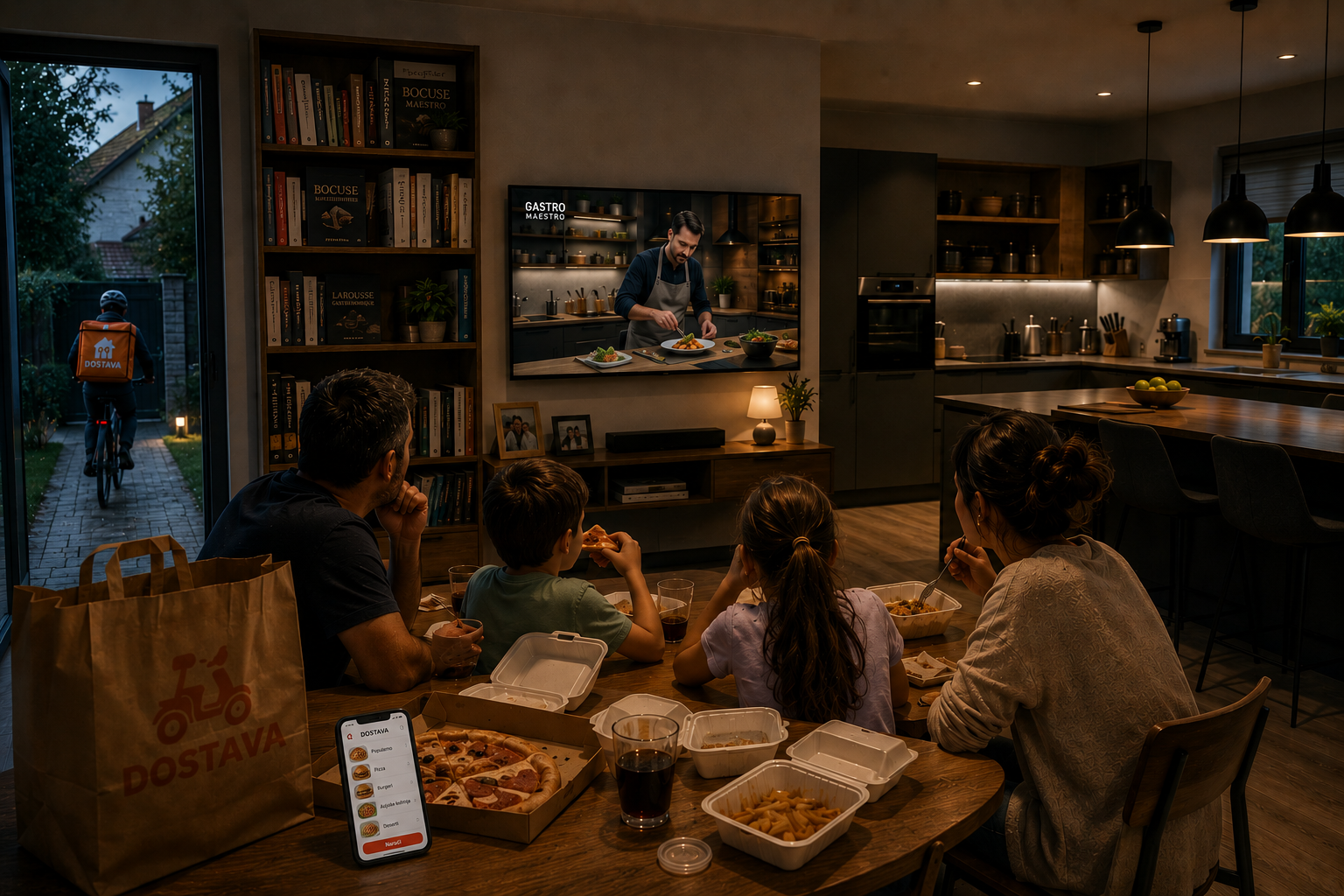
Never have we ordered more food than we do today. Never have there been more restaurants, more delivery services or more ready-made meals. At the same time, never have we watched more cooking shows, televised competitions and food videos.
Cooking is everywhere.
We have television channels devoted entirely to gastronomy, streaming platforms overflowing with culinary content, YouTube, blogs, websites, forums and social media.
Celebrity chefs, once-great culinary names, television personalities, influencers, home cooks, enthusiasts and self-appointed experts all compete for our attention.
Never have so many people talked about cooking, demonstrated recipes and offered culinary advice.
And yet there is a paradox behind all of it.
The more we watch other people cook, the less we cook ourselves.
The paradox is not that food delivery exists.
The paradox is that we have turned cooking into content we consume instead of a skill we practise.
Perhaps the problem is not simply a lack of time.
Perhaps we simply no longer want to stand beside the stove.
It is easier to swipe a finger across a screen than to draw a knife across a chopping board. Easier to tap “Order” than to peel and chop a kilogram of onions. Easier to watch somebody else cook than to walk into your own kitchen and do it yourself.
Perhaps we have tried.
And then reality got involved.
Cooking does not believe in shortcuts.
You cannot skip washing, cleaning and chopping ingredients. You cannot skip heat treatment — blanching, sautéing, sweating, roasting, boiling or frying. You cannot simply speed up the natural process by which ingredients cook and soften.
Every stage takes time.
Every mistake leaves a mark.
And almost every shortcut eventually reveals itself on the plate.
You can cut yourself. Burn yourself. Stain your clothes. Ruin your manicure. You can spend two hours in the kitchen and still produce something thoroughly average.
Then you step outside and realise that the city itself has changed.
A visible part of today’s urban landscape is made up of our newly arrived friends from parts of the world that once seemed very far away, people who have come here in search of a better life. Strange as it may sometimes seem to us, for somebody else, we are the West.
For somebody else, we are the promised land.
You see them on electric bicycles, moving quickly through streets, pavements and parks, the familiar yellow and blue insulated delivery bags strapped to their backs.
You do not hear them approaching.
You simply feel the rush of air as they pass.
In those brief encounters, you usually exchange only a few words of English.
Enough to understand one another.
Then everyone continues on their way.
They move from restaurant to restaurant. From one address to another.
Because every delivery means another payment.
While they race through the city to bring us lunch, we sit in front of screens watching somebody else cook.
Perhaps that is one of the most telling images of our time.
Some people cook for the camera. Others watch. Others deliver. And fewer and fewer people actually cook.
I often hear that the reason is lack of time.
Then I think about our parents and grandparents.
They worked eight-hour days too. They worked shifts. They did night duty. Many had physically demanding jobs.
And they did not have the machines that save us time today. No robot vacuum cleaners. No dishwashers in every kitchen. No microwave ovens. No groceries arriving at the door with a tap on a screen.
They had to do it themselves.
Walk to the shop. Walk to the market. Then pick up the knife and put the pot on the stove.
Shops were not open twenty-four hours a day. There were no apps and no ready-made meals on every corner.
And yet…
In a vast number of homes, lunch was cooked every single day.
Usually by mothers, but by fathers too.
There was almost always something on the table that you ate with a spoon.
Cooking was not a hobby.
It was not a television format.
It was not content.
It was part of life, and one of the foundations of a functioning home.
And their lives were not confined to work and home.
They went to the cinema. To dances. To football matches. On day trips. They sat with friends, neighbours and relatives.
They did not have more time than we do.
They had the same twenty-four hours.
They simply had far fewer machines designed to save it.
Perhaps, then, the problem is not time.
Perhaps the problem is what we have chosen to do with it.
This is not a story about delivery riders. They are doing their job.
It is not really a story about the neighbour whose kitchen produces those smells.
Nor is it a story about cooking shows.
It is not even a story about why there is a shortage of professional cooks today.
This is a story about us.
About how we turned one of the most important basic life skills into something we watch.
How we replaced the pot with an app.
Cooking with a click.
Learning with a scroll.
Because the kitchen does not teach us only how to cook.
It is where some of our first working habits are formed.
It is where we learn that nothing worthwhile appears at the press of a button. That mistakes are not a reason to give up, but part of learning. That knowledge is not something you download.
It is something you acquire.
And that is precisely where the difference lies.
Cooking does not require motivation.
Motivation lasts only as long as enthusiasm does.
Cooking requires discipline.
It requires you to return to the stove day after day. To repeat the same movements. To make mistakes. To correct them. To learn.
To accept that there is no fast-forward button.
And that is how, little by little, you become better.
Author: Nikola Skeledžija
© 2026 Nikola Skeledžija. All rights reserved. Quotation is permitted with proper attribution to the author and source. Reproduction, distribution or adaptation of this text, in whole or in part, without prior written permission of the author is prohibited.